App Packaging, Installation, and Upgrade
Overview
After development is complete, DejaOS apps need to be packaged and deployed to target devices. Taking DW200 as an example, the typical process is as follows:
- Purchase a small number of development devices for debugging and complete JavaScript app development.
- Package the app.
- Install or upgrade the packaged app to multiple production devices.
App Packaging
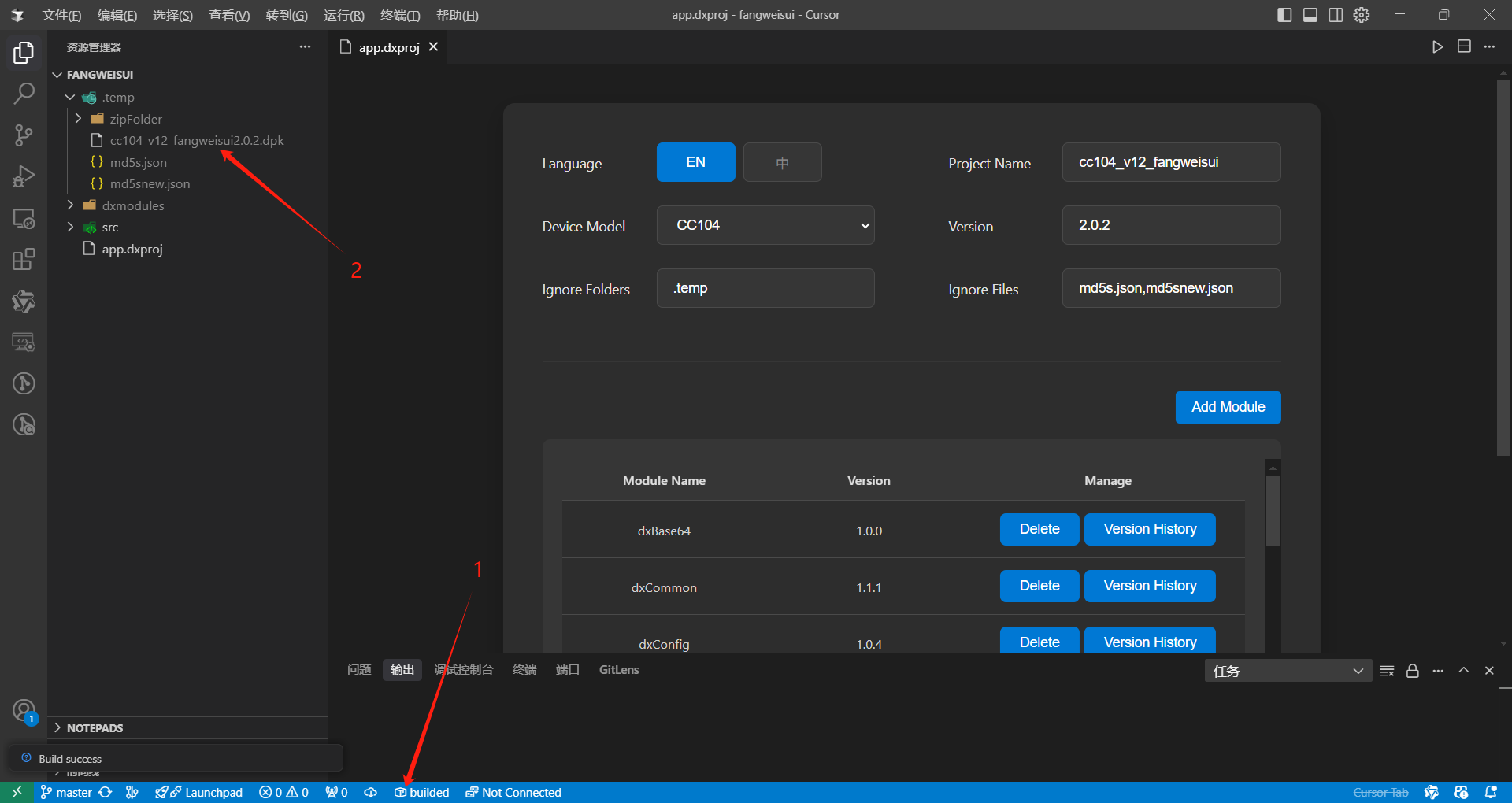
You can package with one click through the DejaOS plugin in VSCode, generating .dpk files:
App Installation
Solution 1: Use Standard Product Apps with Built-in Upgrade Capability
Purchase production devices (default official standard apps pre-installed), then use the following features for remote upgrades:
- By Standard Product Type:
- Access control standard products support MQTT upgrades.
- By Device Capability:
- QR code scanning devices support scan-to-upgrade (e.g., scanning a QR code containing an upgrade link).
- Note: QR code access control devices will have dual upgrade capabilities (QR code scanning + MQTT).
Solution 2: Official Production Pre-installed Apps
Provide the completed .dpk app package to DejaOS official. The official will assign a version ID (e.g., vf205_v12_dejaxxx_2.0.0) and pre-install it on devices during factory production. This solution is suitable for large-scale deployments.
Note: The official only ensures the app can start and does not perform detailed business logic testing by default. Additional customization fees may apply.
Solution 3: Manual Installation
- DejaOS 2.1.0+: Use Device Manager Mode, please refer to Manager App Doc. Suitable for small batch or multiple iteration project scenarios.
- DejaOS 2.0.0: Use RS485 + dejaos_tools to install
.dpkapp packages. Suitable for small batch or multiple iteration project scenarios.
App OTA Upgrade
App upgrades are implemented by the app itself, offering high flexibility and customization capabilities.
Basic Principle of OTA Upgrade
- Deploy the
.dpkfile to a Web service and calculate the MD5 value of the file (for integrity verification). - Push the HTTP URL corresponding to the
.dpkfile to the device (usually notifying the device via QR code or network message). - The device downloads the
.dpkfile based on the URL and places it in a specific system directory. - After the device restarts, the system will automatically detect and install the
.dpkfile, overwriting the old version.
Implementation Suggestions
It is recommended to use the built-in dxOta component in the app to add upgrade logic. dxOta encapsulates the above download and installation process; you only need to prepare the .dpk file and deploy the service.
dxOta.updateHttp: Download and upgrade via HTTP URL.dxOta.updateFile: Upgrade directly via local file path.
References
- GitHub Example Code: dw200 App QR Code Upgrade Example
- GitHub Example Code: dw200 App Network Batch Upgrade Example
- OTA Detailed Description: Please refer to OTA Best Practice.